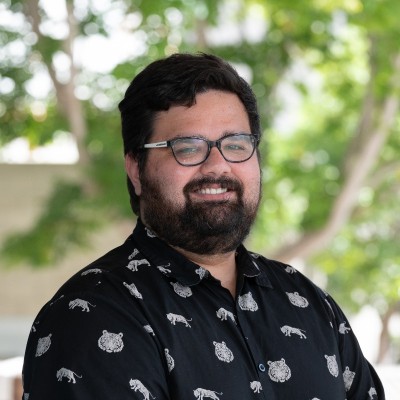
About me
I am a Jansky Postdoctoral Fellow at the National Radio Astronomy Observatory in Charlottesville, Virginia. I am a radio astronomer working on molecular astrophysics, galactic structure, and the interstellar medium, with an emphasis on radio spectroscopy of atoms and molecules.
The question that drives most of my work is simple to ask and hard to answer: how much molecular gas is actually available to form stars in a galaxy? The standard tracer of molecular gas, carbon monoxide, goes dark in exactly the diffuse, low-density conditions where a great deal of that gas lives. I use the ground-state 18 cm lines of the hydroxyl radical (OH) — together with HI, CO, and dust — to find and weigh the molecular gas that CO surveys miss.
Getting here
I started in radio astronomy as an undergraduate at Arizona State University, where I earned B.S. degrees in Physics and Astrophysics in 2016 and wrote an honors thesis with Dr. Judd Bowman on characterizing extragalactic radio foregrounds for the Murchison Widefield Array. Along the way I spent a summer on an NSF international REU in Bochum and Hamburg measuring galactic magnetic fields, and another at Michigan with Dr. Eric Bell on the stellar halo of M83.
I then went to The Johns Hopkins University as an NSF Graduate Research Fellow, taking a master’s with Dr. Adam Riess on a sub-2% Cepheid distance to M31 before completing my Ph.D. in Physics in 2022 with Dr. Josh Peek and Dr. Ronald Allen. My thesis, On the Dark Molecular Gas as Revealed by 18 cm OH Emission, is what set the direction I am still following. I held an NSF Astronomy and Astrophysics Postdoctoral Fellowship at the University of California, San Diego with Dr. Karin Sandstrom from 2022 to 2025, and joined NRAO as a Jansky Fellow in 2025.
Most of my observing happens on the Green Bank Telescope, the Very Large Array, ALMA, and Murriyang (the CSIRO Parkes 64 m telescope) — 2,803 hours of awarded time since 2019. The research page covers the individual projects and programs, and the papers are on the publications page.
Awards and fellowships
- Jansky Postdoctoral Fellowship, NRAO (2025–present)
- NSF Astronomy and Astrophysics Postdoctoral Fellowship (2022–2025)
- LSSTC Data Science Fellowship, Cohort 3 (2019–2021)
- NSF Graduate Research Fellowship (2016–2021)
As an undergraduate at ASU I was twice named Astrophysics Undergraduate Student of the Year, held a NASA Space Grant Fellowship three times, and received the inaugural Origins Project Undergraduate Research Scholarship.
Service
I referee for The Astrophysical Journal, Nature, and the Journal of Astronomical Telescopes, Instruments, and Systems. I served on the Hubble Space Telescope Cycle 33 Telescope Allocation Committee, the FAST Time Allocation Committee, and the GBT Science Advisory Committee for ALPACA (now defunct). I have been on the scientific organizing committee for several meetings — OH What a Lovely Molecule, Contents of the Fermi Bubbles, and GBT Surveys of the 21 cm Sky — and I co-organize the NRAO TUNA Lunch Talks seminar series.
Get in touch
The best way to reach me is by email at mpbusch@nrao.edu. I am always glad to hear from students interested in radio astronomy — the students page describes what working with me tends to look like.