
Research
Galaxies form stars out of molecular gas, so measuring how much molecular gas a galaxy has is a precondition for understanding how it grows. That measurement is harder than it sounds. Most of our census of molecular gas comes from carbon monoxide, but CO is fragile: in diffuse, weakly shielded gas it is photodissociated away while the hydrogen molecules survive. The result is “CO-dark” molecular gas — real molecular material that simply does not show up in the surveys we use to find it.
My work is largely about finding that gas, weighing it, and figuring out what it means for star formation. The main tool is the ground-state 18 cm hyperfine lines of the hydroxyl radical (OH), which stays visible where CO does not.
CO-dark molecular gas in the Milky Way
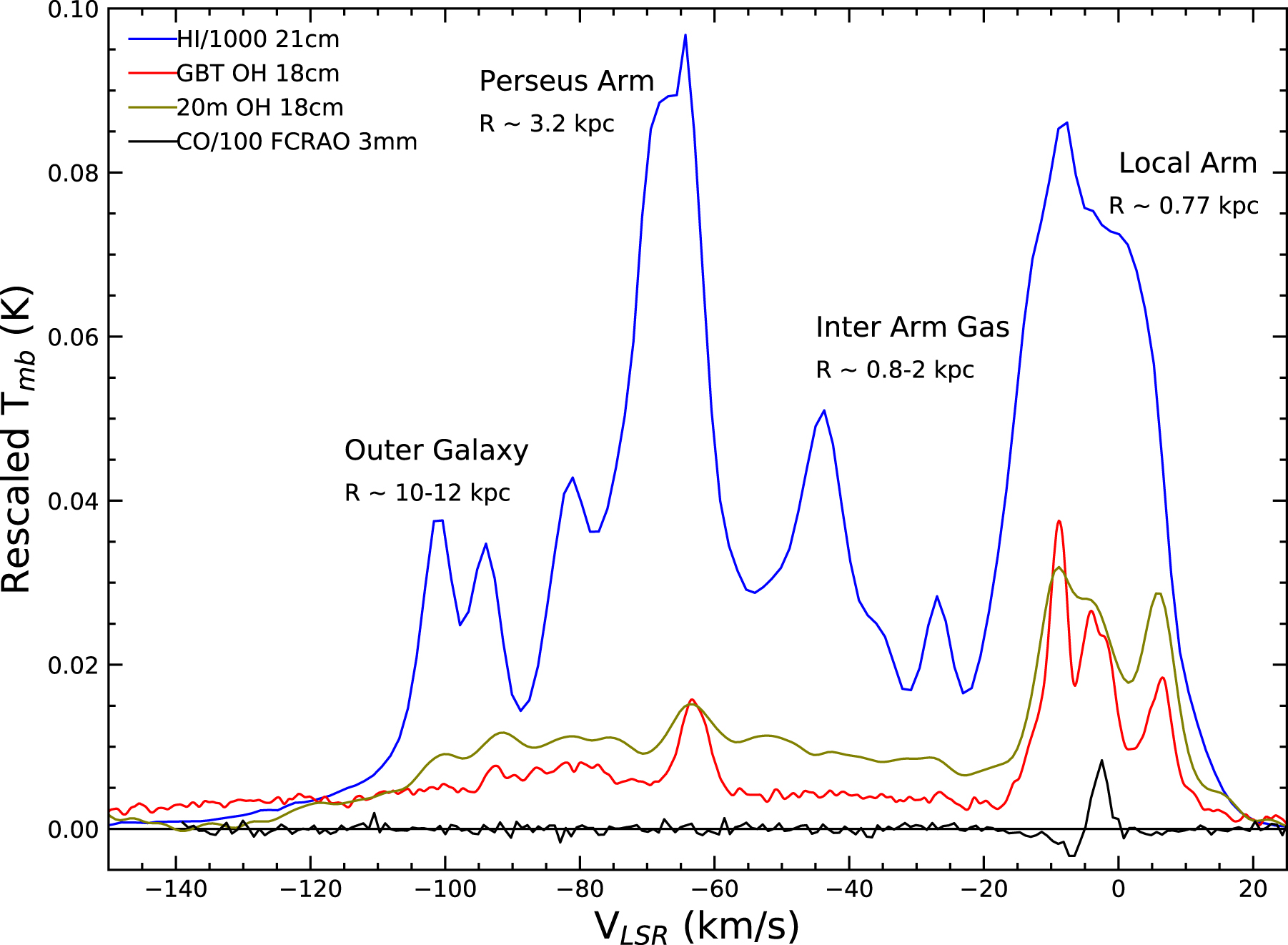
My thesis work used the Green Bank Telescope to survey 18 cm OH emission in the outer Galaxy and the Perseus Arm, where the CO-dark fraction should be largest. Two results came out of it. First, OH emission is widespread in regions with no detectable CO, and the gas it traces is diffuse and cold rather than clumped into recognizable clouds (Busch et al. 2019). Second, this material is not confined to the thin molecular disk — there is a thick disk of dark molecular gas extending well off the Galactic plane, which conventional CO-based inventories miss entirely (Busch et al. 2021).
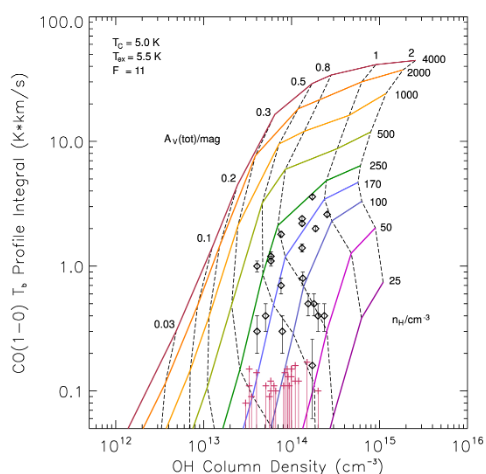
Taken together, these say that the molecular reservoir of the Galaxy is both larger and more extended than the CO maps imply.
CryoPAF on Murriyang
Surveys of faint, extended emission are limited by how much sky you can see at once. A single-pixel receiver looks at one point on the sky; a phased array feed forms many beams simultaneously, turning the telescope into a proper survey instrument for exactly the diffuse signals I care about.
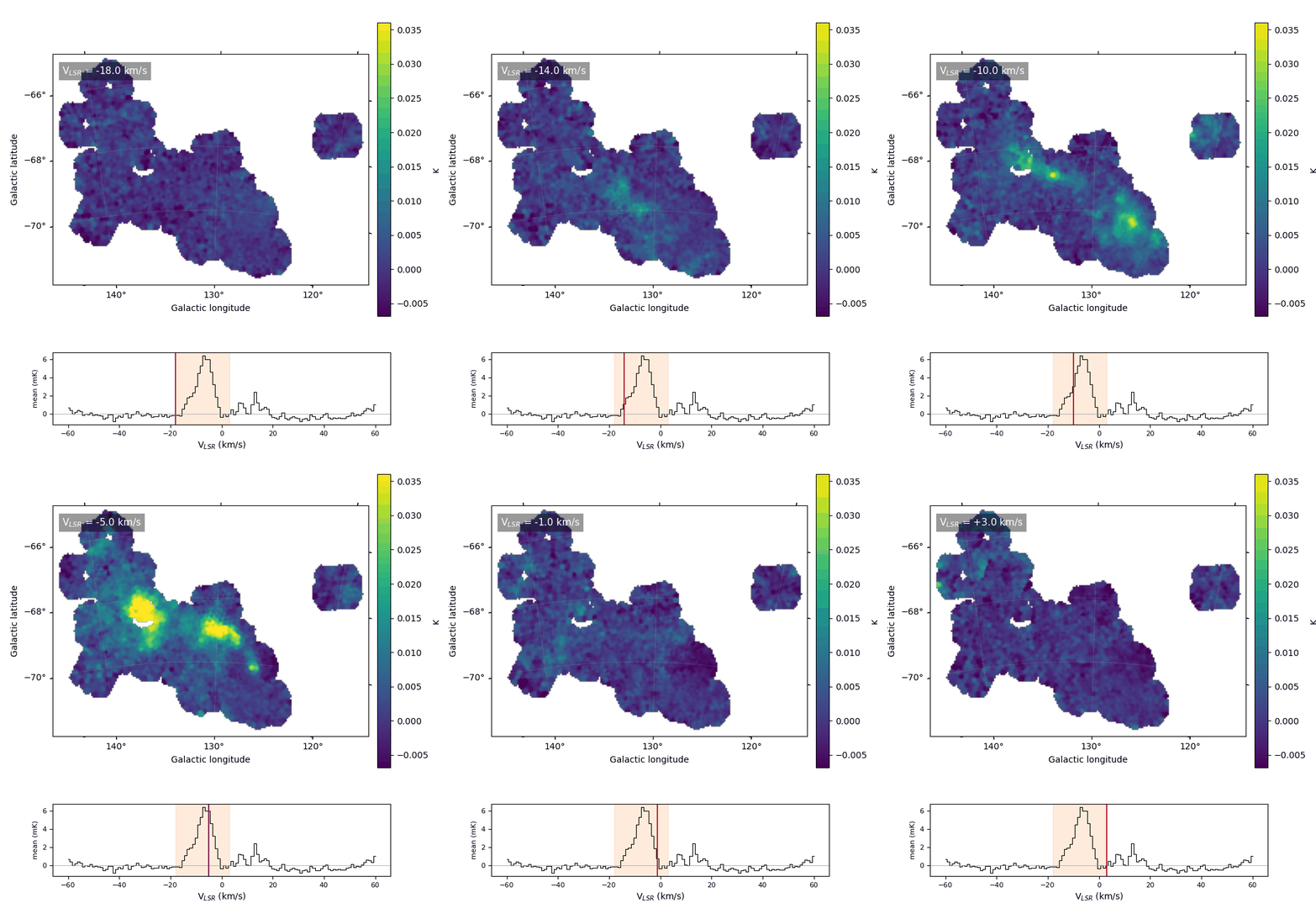
I am currently working with CryoPAF, the cryogenically-cooled phased array feed on Murriyang, the CSIRO Parkes 64 m telescope. A cooled PAF is the combination that matters here: the wide field of view makes large-area mapping tractable, and the cryogenic front end keeps the system temperature low enough that genuinely faint diffuse HI and OH stay within reach. The goal is to map the diffuse molecular interstellar medium over far more sky than pointed observations have allowed.
The first step is a 100-hour Murriyang program (P1385) mapping OH in a high-latitude cloud — a region where the CO-dark fraction should be high and the emission faint enough that the survey speed of a cooled PAF is what makes the measurement possible at all.
Extragalactic OH and the Local Group
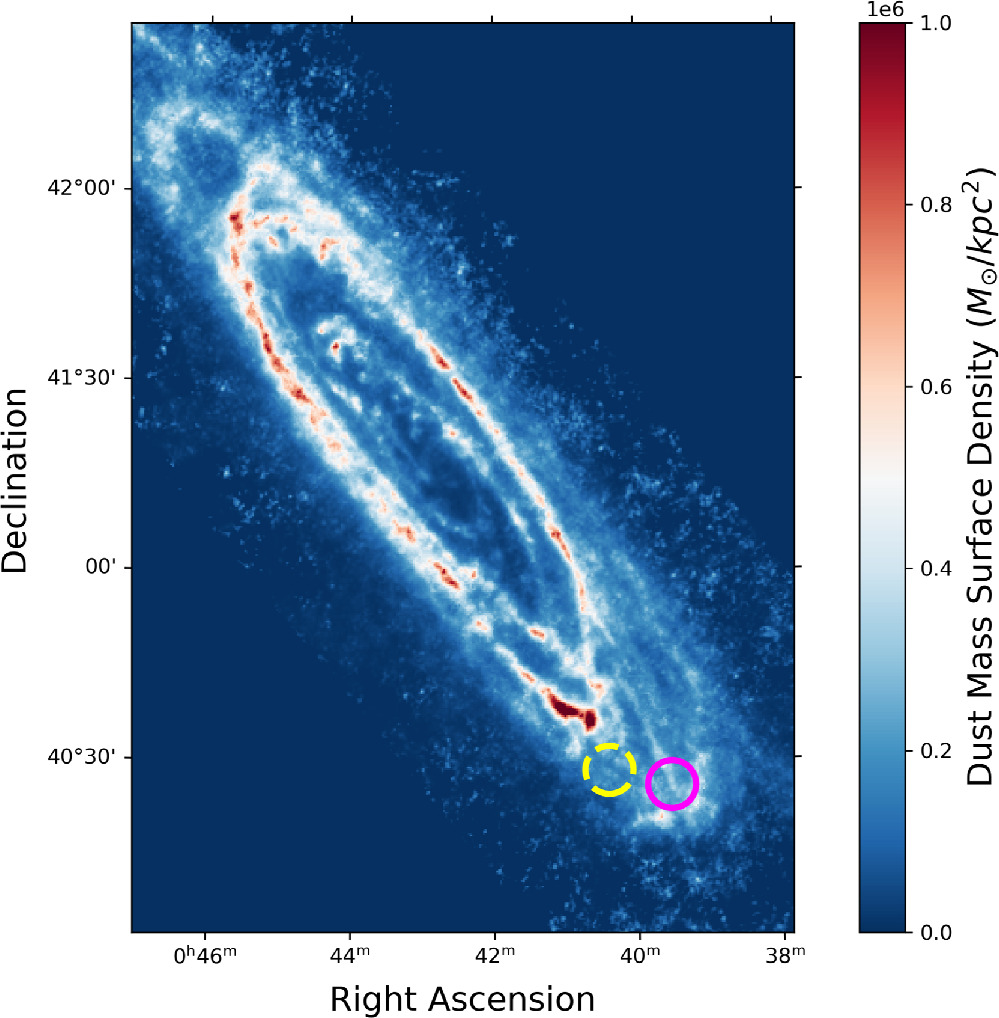
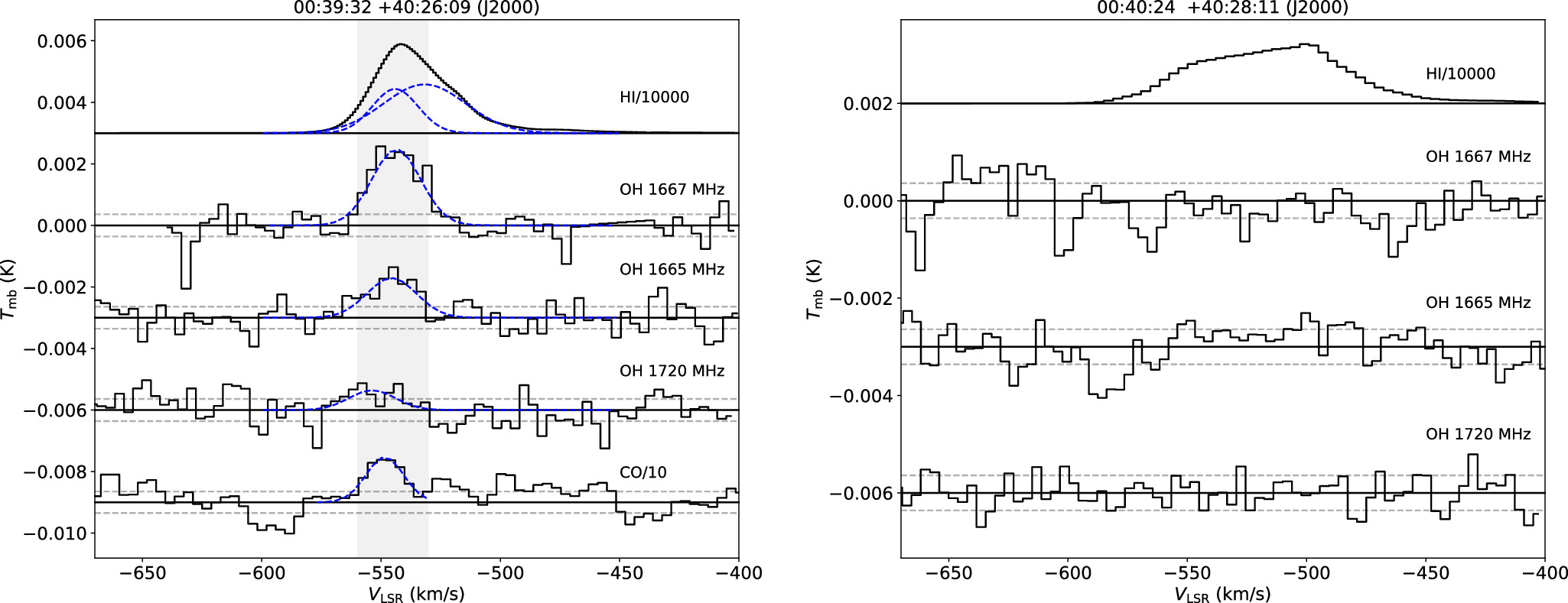
If OH reveals hidden molecular gas in the Milky Way, it should do the same in other galaxies — but until recently nobody had detected thermal OH emission outside our own. Using the GBT, I realized I could carry out a pilot search in nearby galaxies for the same signal I had found in the Milky Way. I reported the first extragalactic detection of thermal 18 cm OH emission, toward Andromeda (M31), and found it traces an abundant reservoir of CO-faint molecular gas (Busch 2024).
This opens the technique up to the Local Group, where I also work on cold gas in low-metallicity dwarf galaxies through the Local Group L-band Survey (LGLBS) with the VLA — systems like NGC 6822, IC 10, and WLM, where low metallicity should make the CO-dark fraction larger still.
The diffuse ISM in absorption
Emission is not the only way to find this gas. Absorption spectroscopy against bright background continuum sources gives a sharp, sensitive probe of individual diffuse clouds along a sightline. I contribute to work using HCO+ absorption to trace CO-dark gas in the diffuse ISM, and to the HyGAL program, which characterizes the Galactic interstellar medium through hydrides and other small molecules. These absorption measurements provide the physical conditions — temperature, density, abundance — that the emission surveys need in order to be converted into masses.
Observing programs
Most of this work depends on getting large amounts of time on single-dish and interferometric telescopes, since diffuse emission is faint and the surveys have to be wide. Since 2019 I have been awarded 2,803 hours as PI or co-I across the GBT, the VLA, ALMA, NOEMA, and Murriyang. A representative sample:
| Program | Facility | Time |
|---|---|---|
| Is the broad 18 cm OH emission “disk” in concordance with Galactic structure? | GBT | 300 h |
| Deep OH absorption in the Outer Galaxy (co-I) | VLA | 350 h |
| Probing the structure of the diffuse molecular ISM — mixed or clumped? | GBT | 216 h |
| A GBT search for the diffuse molecular gas disk in absorption | GBT | 177 h |
| A survey for OH in the northern molecular ring of M31 | GBT | 176 h |
| A GBT survey of M33’s molecular gas in OH | GBT | 168 h |
| Turbulent motions, mass content and distribution of dark H2 in the Outer Galaxy | GBT | 135 h |
| Extending the GBT M31 molecular ring survey in OH | GBT | 132 h |
| A follow-up survey for OH in the Milky Way’s nuclear wind | GBT | 121 h |
| Tracing dark molecular gas in the Eos molecular cloud with 18 cm OH | GBT | 100 h |
| CryoPAF mapping of OH in a high-latitude cloud | Murriyang | 100 h |
| An ultra-deep search for OH and CH in the diffuse ISM of the Magellanic system | Murriyang | 100 h |
| Detangling the 3D multi-phase structure of the Perseus cloud with 18 cm OH | GBT | 92.5 h |
Alongside these I contribute to multi-tracer NOEMA and VLA programs on the structure and chemistry of diffuse molecular gas near the HI-to-H2 transition.
Interested in working on any of this? See the students page, or just email me at mpbusch@nrao.edu.